Validate your AI or Platform Idea in 40 Engineering hours. Talk to our Expert →


The Illusion of a Solved Problem
Over the past few years, “AI on documents” has become one of the most confidently oversold problem spaces in enterprise software. The promise is simple: upload your documents, ask questions in natural language, and let the system reason over them. With modern OCR, embeddings, and large language models, this appears not only feasible but inevitable.
And yet, very few such systems survive real production use.
This failure is often attributed to model limitations or data quality, but those explanations miss the core issue. Most document AI systems fail because they are built on a shallow understanding of what documents are.
Documents Are Not Passive Text
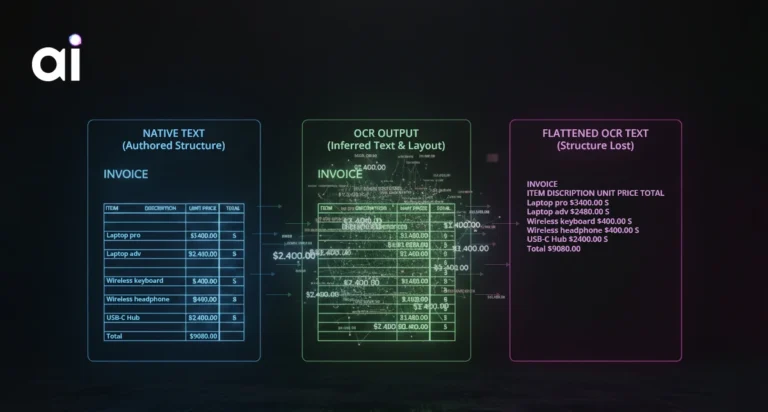
Documents are not passive containers of text. They are structured artifacts designed for human interpretation. The meaning is conveyed through layout, hierarchy, tables, cross-references, footnotes, and contextual placement.
When these signals are flattened into raw text during ingestion, the system permanently loses information that no downstream model can reliably reconstruct. At that point, even a highly capable language model is forced to infer structure that no longer exists.
The outputs may sound coherent, but they are grounded in approximation rather than representation. This is why such systems often feel impressive in demos yet behave inconsistently in practice.
The Query-Time Intelligence Trap
Another recurring failure comes from pushing intelligence to query time. Many architectures defer understanding until the moment a question is asked, relying on retrieval and real-time reasoning to “figure things out.”
This approach is attractive because it minimizes upfront effort, but it creates unstable systems. Every query becomes an expensive, probabilistic interpretation of noisy context. Latency fluctuates, costs scale unpredictably, and answers vary across runs.
In controlled environments, this variability may be acceptable. In production systems, it is not.
Why Accuracy Metrics Don’t Save You
Teams often attempt to compensate by improving accuracy metrics, but accuracy alone is not what breaks document systems in the real world.
What breaks them is the inability to explain decisions, to debug failures, to trace answers back to source documents, and to reason consistently across document versions. When stakeholders ask why the system produced a particular output, “the model inferred it” is not a defensible explanation.
At that point, the system stops being a tool and starts being a liability.
The Engineering Reality Most Teams Miss
The uncomfortable truth is that document intelligence is not an LLM-first problem. It is a systems engineering problem.
Strong systems invest heavily in ingestion-time intelligence: preserving layout, resolving structure, extracting entities, and stabilizing knowledge before it is ever queried. Language models, when used, operate on top of this foundation rather than compensating for its absence.
LLMs are powerful amplifiers of good architecture. They are poor substitutes for it.
Why Production Exposes Everything
The systems that endure are not the ones that maximize model usage, but the ones that impose discipline: clear separation between ingestion and querying, explicit knowledge representation, controlled reasoning boundaries, and design choices informed by cost, auditability, and failure modes.
Most “AI on documents” systems fail not because the technology is immature, but because they were designed to impress quickly rather than operate reliably.
In production, architecture always matters more than answers.