Validate your AI or Platform Idea in 40 Engineering hours. Talk to our Expert →

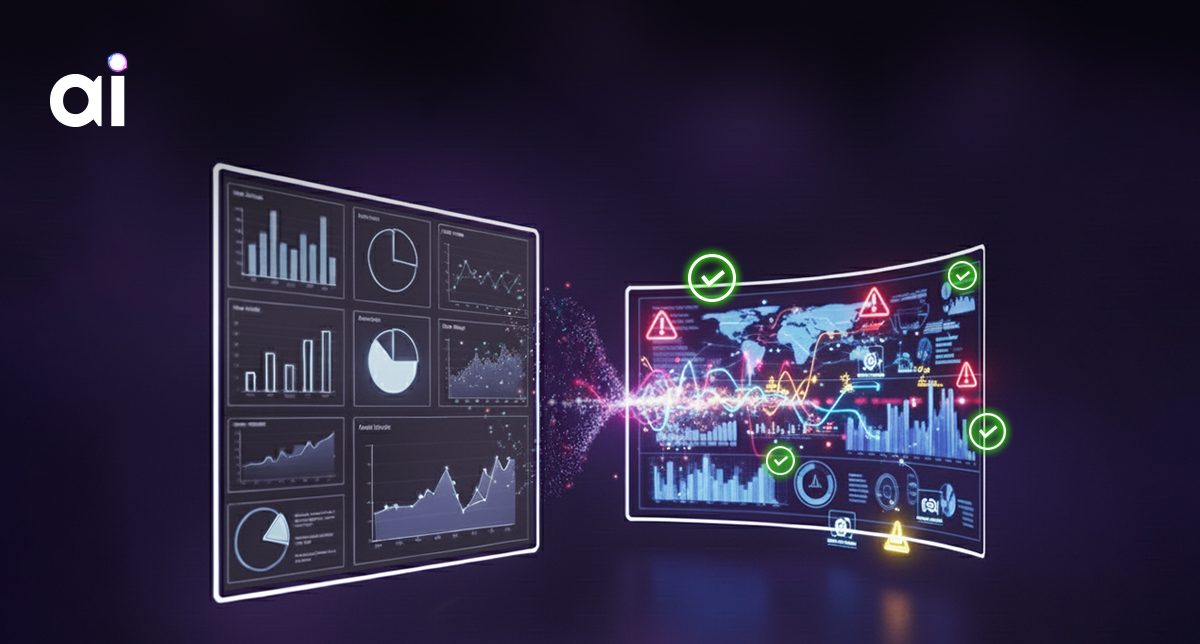
Dashboards have become the default way organizations monitor systems. Charts, metrics, and alerts give the impression of visibility and control.
But visibility alone does not prevent failure.
In many real-world systems, by the time humans notice a dashboard alert, the damage has already begun.
Dashboards are designed to answer one question: “What is happening right now”.
They aggregate data, summarize trends, and present system health in a readable format. This is useful for reporting and post-incident analysis.
However, dashboards are passive by design.
They observe. They do not act.
In operational environments, decisions often need to happen in milliseconds.
Examples include:
These scenarios do not allow time for:
When response depends on dashboards alone, systems remain reactive.
The core problem is not data quality.
The problem is the gap between:
Dashboards sit at the end of the data pipeline. They assume a human is a decision maker.
Modern systems cannot afford that assumption.
Action-oriented systems are designed differently.
They follow a simple principle.
Decisions must happen as close to the event as possible.
This requires:
Dashboards still exist, but they are no longer the first line of defense.
Edge technology enables systems to:
Instead of streaming all data to the cloud and waiting for human intervention, edge systems act first and report second.
This shift reduces latency, risk, and operational overhead.
Dashboards are not obsolete.
Their role evolves.
In action-driven systems, dashboards are used for:
They support decisions instead of making decisions.
The most reliable digital systems share a common trait.
They do not wait.
They detect, decide, and act automatically, while keeping humans informed, not burdened.
Dashboards cannot deliver that capability.
Systems designed for action can.
Monitoring is necessary, but it is not sufficient.
As systems become faster, more distributed, and more critical, organizations must move beyond passive visibility. The future belongs to systems that act in real time, not just report it.