Beyond the Blue Dot: Why Indoor Navigation is the Killer App for AR
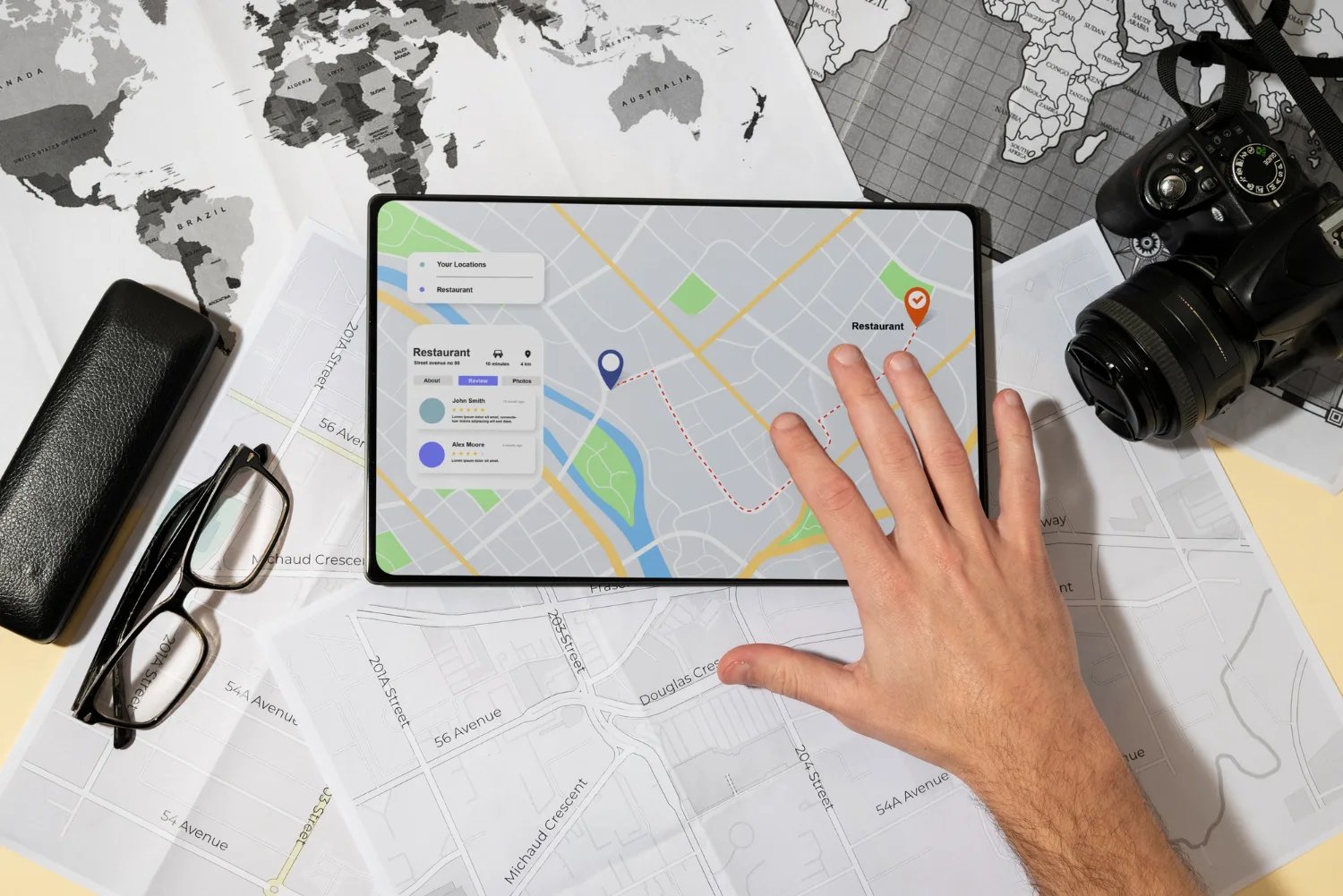
We are witnessing a quiet revolution in how machines understand space. For decades, navigation meant following a 2D blue dot on a screen, a paradigm limited by GPS accuracy (or lack thereof indoors) and the cognitive load of constantly glancing down at a phone.
With emerging hardware like Meta’s Orion and the Google XR platform, combined with rapid advances in semantic scene understanding, we are moving from finding directions to being guided intelligently through physical spaces. This isn’t just about arrows on a screen; it’s about spatial intelligence.
Here is how the convergence of interface, perception, and experience is solving the “last mile” of navigation.
1. The Interface: Smart Glasses as the “Always-On” Guide
The form factor is finally catching up to the function. The limitations of handheld navigation, such as looking down, orienting the map, looking up, and walking, are solved by placing the interface directly in the user’s line of sight.
Meta’s Approach: With the Orion prototype and Ray-Ban Meta series, the focus is on multimodal AI. The glasses don’t just display a map; they “see” what you see. You can look at a complex airport terminal and ask, “Where is the lounge?” The system identifies your location not just by coordinates, but by visual landmarks.
Google XR & Android XR: Google is leveraging its massive geospatial dataset. By integrating Gemini with visual data, future XR devices (like the upcoming Samsung XR hardware) will likely support “Immersive View” capabilities locally, overlaying pathfinding data directly onto the physical world with high fidelity.
2. The Perception Layer: From SLAM to Semantic Understanding
The real technical breakthrough lies in Computer Vision (CV). Traditional SLAM (Simultaneous Localization and Mapping) was good at building a sparse map of points to keep a device oriented. Today, we are moving toward Semantic Scene Understanding.
To navigate effectively indoors, the system must do more than avoid walls; it must understand context.
Visual Positioning Systems (VPS): Unlike GPS, which fails indoors, VPS uses a device’s camera to match feature points (edges, textures) against a pre-built 3D map of the world. This allows for centimeter-level accuracy in malls, factories, or campuses.
3D Semantic Segmentation: P(c | I) = f(x, theta) Where the model assigns a class label c (e.g., “door,” “elevator,” “obstacle”) to every pixel in the input image I. This allows the navigation engine to distinguish between a navigable path and a glass wall.
Occupancy Networks: Modern navigation stacks use learning-based approaches to predict occupancy in 3D space, allowing the AR system to plan paths around dynamic obstacles (like people or forklifts) in real-time.
3. The Experience Bridge: Scalability in Enterprise
This technology is rapidly graduating from novelty to utility. The ability to overlay digital directions onto the physical world is scalable across industries:
Warehousing: Pick-and-pack workers receive “tunnel vision” guidance to the exact bin location, reducing search time by nearly 40%.
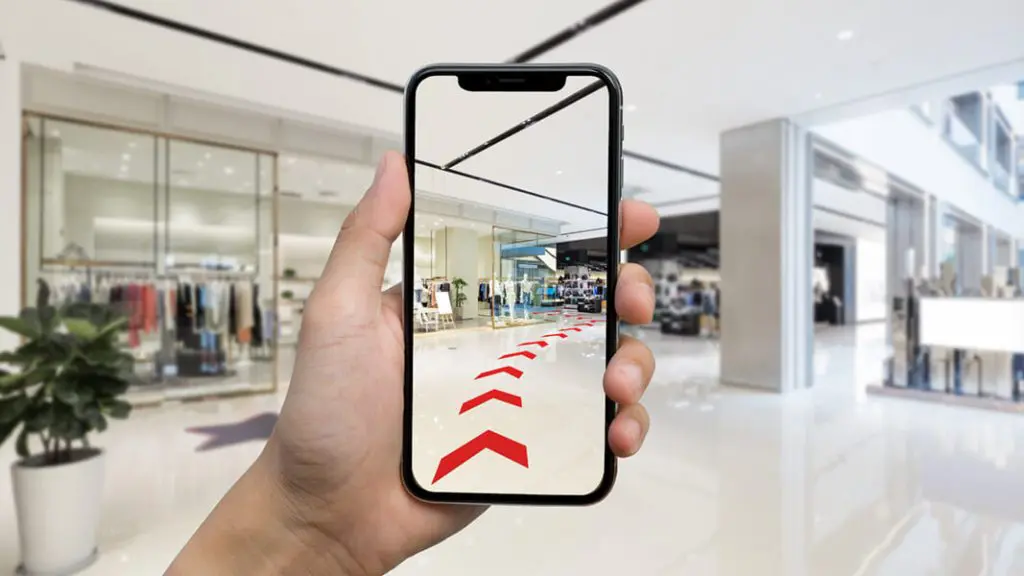
Healthcare: Visitors in massive hospital complexes can be guided via AR arrows on the floor (viewed through glasses) to specific wards, reducing staff interruptions.
Public Transit: VPS-enabled glasses can guide users from a subway platform to the exact street exit required, bridging the gap between underground and street-level navigation.
The Convergence
The future of navigation won’t be on a screen, it will be all around you. As Spatial Computing matures, the “blue dot” will disappear, replaced by a subtle, intelligent overlay that understands the world as well as you do.
01. How do you decide the right approach for our use case?
Most teams struggle not with lack of technology, but with too many options like - AI, automation, IoT, digital twins, XR, cloud, edge. Choosing incorrectly often leads to overbuilt or fragile systems.
How Shwaira helps:
Shwaira begins by identifying the decision, process, & system behavior that needs improvement.
We then assess data availability, latency requirements, reliability constraints, and operational risk before defining the technology mix.
This ensures AI, automation, or simulation is introduced only where it creates real system value.
02. We already have systems in place so will this require a full rebuild?
In most cases, no. Many systems fail not because they are outdated, but because they lack observability, automation, or intelligence.
How Shwaira helps:
Shwaira designs architectures that extend existing platforms, devices, and data pipelines.
We integrate intelligence & automation incrementally to modernize systems without disrupting live operations or forcing risky, large-scale replacements.
03. How do you avoid building something impressive that doesn’t work at scale?
A common failure pattern is moving too quickly from concept to full rollout without validating performance, data integrity, or integration complexity.
How Shwaira helps:
Shwaira validates systems early through structured prototypes, technical spikes, and controlled pilots.
We test data pipelines, decision logic, system load, and integration boundaries before scaling, so production systems behave predictably under real-world conditions.
04. When does it make sense to use AI versus automation or rules-based logic?
AI is powerful, but not always the most reliable or cost-effective choice. Many production systems benefit more from deterministic logic, automation, or edge processing, with AI applied selectively.
How Shwaira helps:
Shwaira designs hybrid systems to combine AI models, rules, automation, and simulations where each fits best.
This results in systems that are explainable, resilient, and easier to operate long term.
Stay Ahead of What’s Actually Building!
Subscribe for concise updates on AI-driven platforms, data infrastructure, IoT systems, and execution patterns we use across complex deployments.
Have more questions?
Let’s schedule a short call to discuss how we can work together and contribute to the success of your project or idea.