Validate your AI or Platform Idea in 40 Engineering hours. Talk to our Expert →

In mid-2025, a global automotive manufacturer reported that its factory layout planning cycles had dropped from weeks to days after moving planning workflows into a large-scale simulation environment. Production planners now validate material flow, equipment placement, and spatial constraints virtually long before physical changes are committed on the shop floor.
Instead of learning from failures in the physical world, organizations are increasingly testing decisions inside simulation environments first. This simulation-first approach is quietly becoming one of the most important infrastructure shifts in physical industries since cloud adoption.
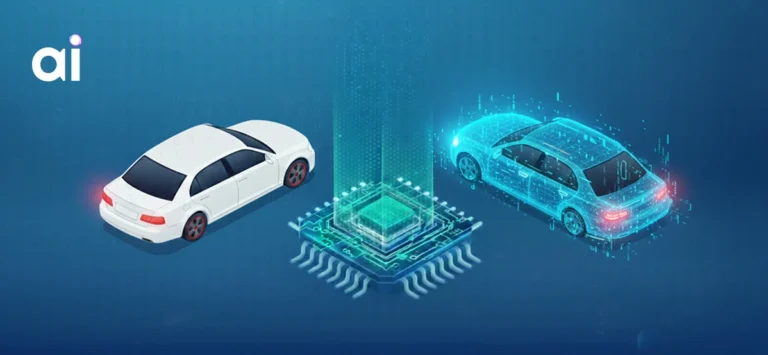
The term digital twin has become vague. In many cases, it still means a static 3D model with live sensor data on top. These systems look impressive and help with monitoring, but they rarely shape real operational decisions. They show what is happening, not what should happen next.
The real shift isn’t better visuals, it’s who makes the decision.
Investment is rising because companies want more than dashboards. They want systems that can predict outcomes, compare options, and test actions before they are executed. This shift is enabled by three key advances:
Together, these technologies turn digital twins from reporting tools into decision infrastructure.
Earlier limitation of advanced simulations has always been compute cost. High-accuracy models like CFD or FEA are reliable but too slow to run continuously, which made them impractical for day-to-day operational decisions.
That limitation is now fading.
AI surrogate models learn from detailed physics simulations and can reproduce system behaviour at a much lower compute cost. Physics-informed models follow the same physical rules, but run tens to hundreds of times faster, with accuracy good enough for real decisions.
As a result:

The cycle begins with World to Twin: ingesting CAD, BIM, point clouds, sensor data, and operational logs to build a geometrically and semantically accurate replica of the physical system. This could be a factory floor, power grid, telecommunications network, or building.
Next comes Twin to Models: training AI surrogates on high-fidelity physics to approximate thermal, structural, fluid, or electromagnetic behaviours in real time. World models learn dynamics from video and sensor streams, capturing how equipment, people, and environments interact over time.
Then Models to Control: integrating those models into planning, scheduling, and optimisation systems. Initially, the twin informs human decisions. Over time, it validates AI controllers and agents before they touch the real system.
Finally, Control to World: new physical behaviours generate data that flows back into the twin. Models retrain. The loop tightens.
This architecture enables something genuinely new: operations where major decisions are rehearsed in simulation before execution, not occasionally for strategic plans, but routinely for daily scheduling and resource allocation.

Not all digital twins deliver the same value. A clear way to judge maturity is to look at what decisions they can support, not how good they look.
Simulation-first doesn’t make sense everywhere. It delivers the most value when three conditions come together:
A scheduling mistake in a warehouse is manageable. A cooling failure in a data center or instability in a chip factory can shut operations down. Systems with high complexity, fast change, and high risk are the best candidates for deep simulation.
At SHWAIRA we help industrial teams move beyond demo-grade digital twins and build simulation-first Physical AI that drives real operational decisions. We design high-fidelity digital models, integrate physics-aware AI, and connect them directly to planning, optimization, and control systems, focusing on the engineering foundations that make simulation reliable at scale.